Assessing dietary supplement manufacturers after a quality complaint means checking traceability, investigation evidence and verified closure, not just replacement stock.
A supplier may answer quickly and still leave the important question unresolved: what happened to the affected units, and could it happen again? A useful review follows the complaint from the first observation through the lot record, sample comparison, decision and follow-up. Speed matters, but the quality of the explanation determines whether the next shipment is a defensible choice.
This is a supplier-evaluation framework, not a finding about a named company's products. NutriCDMO's catalogue and service pages provide examples of product formats and manufacturing discussions. They do not establish the outcome of any specific complaint. The scenarios below are hypothetical; product and process illustrations are not photographs of an incident or evidence of laboratory results.
Start With A Defined Observation, Not An Assumed Cause
Turn A Short Complaint Into A Traceable Record
“The tablets look different” is a starting observation, not a diagnosis. Record the product name, lot identifier, pack version, date received, date opened and what the observer actually saw. Keep photographs of the outer carton, bottle, closure and relevant contents together. Where the report concerns a colour or shape difference, include a comparison under similar lighting rather than relying on a filtered phone image.
Separate The Immediate Response From The Investigation
Holding suspect inventory, arranging an inspection and sending a replacement serve different purposes. An interim decision may reduce exposure while the cause remains uncertain. A credit note settles a commercial issue but does not establish the extent of the defect. The complaint investigation should therefore have its own owner, evidence list and review date, even when the commercial response is already agreed.
For an allegation involving illness, contamination or another possible safety concern, the supplier's qualified quality and regulatory personnel should assess the appropriate escalation for the product and destination. A routine service email is not a substitute for that assessment. Ask who receives urgent reports and how decisions are documented; do not infer a universal reporting deadline from a generic online guide.
- Identify the exact supplied lot and released specification.
- Separate interim stock decisions from the cause assessment.
- Keep the evidence owner and next review visible.
A credible first response preserves the facts, identifies the responsible reviewer and states what is still unknown.
Establish Exactly Which Product And Batch Were Involved
Keep Catalogue Identity Separate From Batch Evidence
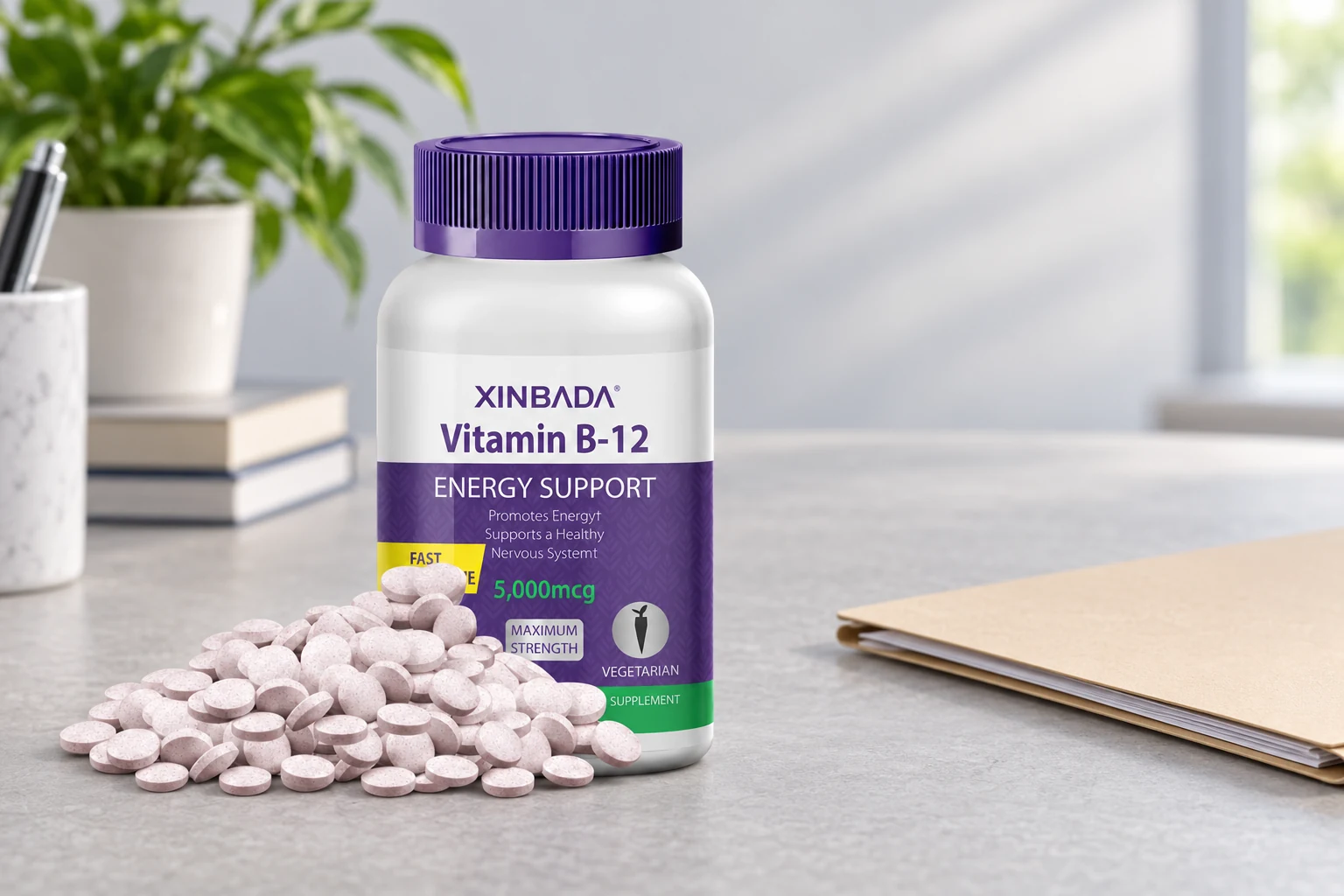
NutriCDMO lists a range of formats through its product catalogue, including the Vitamin B12 tablet product page used for the illustration below. A catalogue image identifies an example package; it does not identify a delivered lot, demonstrate the final agreed formula or prove that the printed artwork applies to a particular market.
Compare the purchase specification and approved artwork with the actual pack involved. If the page description and pictured label use different release or format terminology, resolve that difference through the signed specification rather than choosing whichever statement supports the preferred conclusion. The quality review needs the released product version, not an assumption based on a public photograph.
The manufacturing partnership information can help frame the initial conversation, but the review should request a redacted example of the actual traceability record. Confidentiality can justify masking unrelated customer names. It should not prevent an explanation of how the affected lot connects to the relevant manufacturing and packaging records.
Use Evidence That Can Distinguish Plausible Explanations
Compare Returned Material With A Suitable Reserve Sample
A returned bottle has travelled through a distribution and handling path. A reserve sample may have remained under controlled conditions. Comparing them can help separate possible production variation from later exposure, provided their identity and history are recorded. The comparison is weaker if the samples are different formulations, differently aged or examined using different methods.
Ask how each sample was selected, sealed, stored and transferred to the reviewer. A photograph of an unlabelled container cannot establish its origin. Record when the returned pack was opened, whether the closure was intact and whether the contents were mixed with other units. If the original material is unavailable, the report should explain how that limits the conclusion rather than quietly substituting a different sample.
Choose The Test From The Question
Different observations need different evidence. A tablet count concern calls for a pack reconciliation and an agreed counting procedure. A label mismatch calls for artwork and line-clearance records. A physical appearance concern may require controlled comparison and relevant product testing. A broad certificate supplied before shipment may be useful background, but it does not automatically answer the new allegation.
The FDA's dietary-supplement manufacturing guidance is one source of general context on records, complaints and retained samples within its US scope. It should not be presented as confirmation of compliance in another destination. The useful evaluation principle is narrower: connect the question, the method, the sample identity and the conclusion. Any market-specific obligation needs a separate qualified review.

When dietary supplement manufacturers propose additional testing, ask what result would support or weaken each explanation. A test that cannot distinguish the competing causes may add cost without improving the decision. The report should state the method, relevant acceptance basis and any departure from the planned procedure, with raw observations available to the authorized reviewer where appropriate.
Read The Report As An Evidence Chain
A useful report connects events in a way another reviewer can follow. It need not disclose confidential formulations to every commercial contact. It should identify the issue, scope, evidence reviewed, competing explanations, conclusion and remaining uncertainty. The following comparison is an evaluation aid, not a mandated form or a statement that every complaint requires every listed document.
| Review point | Useful evidence | Weak substitute | Follow-up question |
|---|---|---|---|
| Product identity | Lot and released specification linked to the returned pack | A similar catalogue photograph | Does this record cover the exact version supplied? |
| Extent of the issue | Trace of affected production and shipment allocations | An assertion that only one customer complained | Which related lots and destinations were reviewed? |
| Sample comparison | Identified samples, handling history and a stated method | A new sample with no connection to the complaint | What differences limit comparability? |
| Cause assessment | Observations supporting or excluding each plausible cause | A conclusion copied from an earlier case | Which evidence would contradict the preferred explanation? |
| Closure | Completed action plus a defined effectiveness check | A replacement shipment alone | How will recurrence be detected? |
Look for the distinction between “confirmed,” “probable” and “not established.” A supplier should not claim certainty merely because a familiar explanation is convenient. Conversely, a well-supported conclusion should not remain permanently vague. The report should describe what the evidence can establish and make any unresolved point visible to the person deciding whether to release or reorder stock.
Check Whether Corrective Work Changes The Relevant Process
Match The Action To The Supported Cause
A corrective action should address a cause that the review actually supports. If the evidence points to a packaging-version mix-up, a generic promise to “improve training” is less informative than a defined change to version control and line verification. If handling after dispatch remains a plausible contributor, the plan should identify the evidence needed to resolve that uncertainty rather than assigning blame prematurely.

The site's partnership service description provides a route for discussing responsibilities. The evidence request should still be specific to the agreed product and issue. A broad capability statement cannot show whether a particular action was implemented, checked or sustained after the people handling the original case moved on.
Trace The Decision Beyond The Factory Gate
Reconcile Stock Status Across Handoffs
A factory record does not describe every condition after dispatch. The evaluation should connect remaining factory stock, goods in transit, received inventory and any returned units. Ask which quantities are known, which are estimated and which have not yet been reconciled. A reserve sample can inform the production review while leaving distribution exposure unresolved.

Agree who communicates the disposition to each party holding inventory. A “closed” case should not coexist with an unresolved stock hold simply because the replacement invoice has been issued. The business decision may be release, further inspection, return or another documented outcome selected by the responsible team. Keep that disposition separate from the scientific confidence in the cause.
When comparing dietary supplement manufacturers, request the same level of evidence from each candidate. The NutriCDMO website is a starting source for its stated offering, not an independent ranking. A smaller supplier with a clear, traceable response can be easier to assess than a larger one that supplies impressive but unrelated documents.
Frequently Asked Questions
Does A Replacement Shipment Mean The Complaint Is Closed?
No. Replacement may resolve immediate availability or a commercial obligation. Closure also needs a recorded disposition, an evidence-based conclusion and any necessary follow-up. The case should state explicitly if the cause remains unconfirmed.
Is A Certificate Of Analysis Enough?
It may answer specific tested attributes for an identified batch. It does not automatically address packing errors, later handling or an allegation outside the tested scope. Check the relationship between the certificate, the supplied lot and the exact observation.
Can A Supplier Protect Confidential Manufacturing Information?
Yes. Redaction, controlled review or a signed summary may be appropriate. The remaining evidence should still explain the traceability logic and decision. Confidentiality should not turn an unresolved question into an unsupported assurance.
What If The Returned Sample Is Unavailable?
Use the records and other identified evidence that remain, but state the limitation. An investigation may reach a narrower conclusion. A newly produced sample should not be described as if it proves the condition of the missing material.
Should Every Complaint Trigger A Supplier Change?
No. Evaluate severity, recurrence, response quality and the effectiveness of the documented action. One incident and a repeated unresolved pattern carry different implications. The decision should reflect the available evidence and product risk rather than a promise of zero complaints.
For a concrete supplier review, use the quality enquiry route to request a redacted case example showing lot traceability, evidence reviewed, stock disposition and the effectiveness check; compare that response with the same request made to other candidates.